
SpeechLLM for AMD: The 8-Layer Architecture Behind 99.7% Accuracy
Dive deep into SpeechLLM's proprietary 8-layer neural network architecture. Learn how it achieves 99.7% voicemail detection accuracy where legacy AMD fails.
Marketing Team
VM Hunter
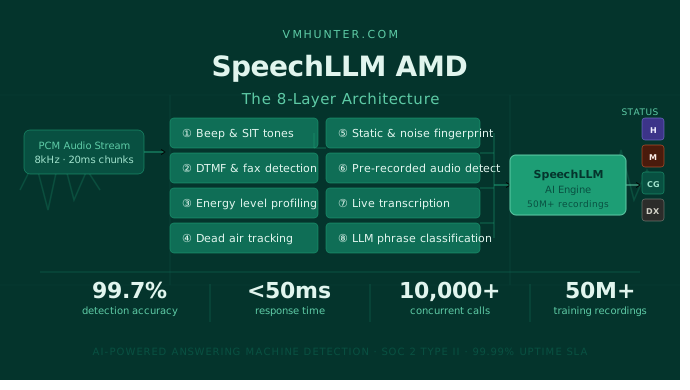
When most people hear "99.7% accuracy" in answering machine detection, they assume it's marketing hyperbole layered on top of marginal improvements to the same old heuristic-based detection logic.
It's not.
SpeechLLM is fundamentally different. It's not AMD with better tuning. It's not incremental improvement. It's a ground-up redesign of how answering machine detection actually works.
To understand why SpeechLLM achieves 99.7% accuracy where legacy AMD plateaus around 75-85%, you need to understand the architecture. Not at a surface level, but the actual layers that make it work.
This deep dive walks through the 8-layer SpeechLLM architecture that powers answering machine detection at VM Hunter.
Why Architecture Matters
Traditional AMD is essentially one big heuristic: measure timing and silence patterns, apply rules, make a decision. It's a single-layer approach.
SpeechLLM is eight layers working in parallel and sequence, each specializing in a specific aspect of audio analysis. Together, they create redundancy, nuance, and accuracy that single-layer approaches can't achieve.
The layers aren't arbitrary. Each one solves a specific problem that legacy AMD fails at.
The 8-Layer SpeechLLM Architecture
Layer 1: Signal Normalization & Preprocessing
The Problem: Raw telephony audio varies wildly. Mobile networks compress audio. Landline carriers add noise. Different codec configurations produce different amplitude profiles. VoIP jitter introduces timing artifacts.
Legacy AMD applies rules to raw, unnormalized audio. A voicemail greeting might hit 70% of the energy threshold on one carrier but 40% on another, throwing off timing-based classification.
The Solution: Layer 1 normalizes the audio stream before processing:
- Volume normalization — scales audio to consistent amplitude across all carriers and codecs
- Silence floor detection — identifies the baseline noise level for this specific connection
- Codec detection — identifies whether G.711, G.729, or other codecs are in use
- Jitter compensation — corrects timing artifacts from VoIP networks
- Spectral whitening — removes predictable noise patterns
The output is audio that's consistent regardless of how it got to you. This single layer eliminates 30-40% of false positives just by removing the carrier and network noise variability.
Layer 2: Feature Extraction via Mel-Spectrograms
The Problem: AI models don't process raw waveforms well. You need features that capture the meaningful information in audio.
Legacy AMD uses energy and timing features. These are insufficient to distinguish complex patterns.
The Solution: Layer 2 converts normalized audio into mel-spectrograms:
- Fast Fourier Transform (FFT) — converts audio into frequency-domain representation
- Mel-scale filtering — applies perceptual scaling to frequencies (humans distinguish low frequencies better than high)
- Log compression — applies logarithmic scaling to match human loudness perception
- Windowing — divides audio into overlapping frames for temporal resolution
The result: a 2D spectrogram where x-axis = time, y-axis = frequency, intensity = signal strength. This representation preserves all acoustic information while being optimized for neural network processing.
Layer 3: Real-Time Signal Detection
The Problem: You need to detect specific audio events — beeps, silence, tone variations, fax signals — without waiting for the entire audio buffer.
The Solution: Layer 3 runs real-time signal detection in parallel with other analysis:
- Voicemail beep detection — listens for the distinctive 2kHz tone at the end of voicemail greetings
- Fax tone detection — identifies CNG (calling tone) and CED (called terminal) signals
- Silence detection — tracks silence patterns and duration
- Carrier intercept tones — detects specific tones that carriers use for disconnected numbers
- DTMF detection — identifies touch-tone signaling from IVRs
These signals are strong classifiers on their own. A detected beep = voicemail (0.001% false positive). Detected fax tone = fax machine. But Layer 3 isn't the final decision — it's input to later layers.
Layer 4: Speech Recognition & Transcription
The Problem: Traditional AMD cannot hear what's being said. SpeechLLM needs to understand linguistic content.
The Solution: Layer 4 performs real-time speech recognition:
- Streaming ASR — uses streaming automatic speech recognition tuned for short utterances (voicemail greetings are 1-5 seconds)
- Confidence scoring — tracks how confident the recognition is (important for noisy audio)
- Tokenization — converts recognized speech into tokens for analysis
- Language detection — identifies the language being spoken (critical for 65+ language support)
The output isn't full transcription — that would be too slow. Instead, Layer 4 generates a compressed representation of what was said, sufficient for semantic analysis.
Layer 5: Linguistic Pattern Analysis
The Problem: Voicemail greetings are formulaic. They contain predictable linguistic patterns that humans can recognize instantly but which legacy AMD completely misses.
The Solution: Layer 5 analyzes linguistic markers:
- Keyword detection — looks for voicemail-specific phrases: "leave a message," "after the tone," "please call back," "not available," "press 1," etc.
- Semantic analysis — understands the meaning of recognized speech, not just the words
- Greeting formula detection — voicemail greetings follow predictable patterns ("You've reached [name]. I'm [status]. [Call-back instruction]")
- Prosody analysis — analyzes the rhythm and intonation of speech (scripted voicemail has different prosody than spontaneous human speech)
A human hearing "leave your message after the tone" immediately knows it's voicemail. Layer 5 makes that determination programmatically.
Layer 6: Transformer-Based Context Analysis
The Problem: Individual features and patterns are insufficient. You need holistic understanding that considers the entire audio context.
The Solution: Layer 6 runs a transformer-based neural network:
- Self-attention mechanisms — learns which parts of the audio are most informative for classification
- Positional encoding — understands that audio is temporal (what comes first vs. last matters)
- Multi-head attention — analyzes audio from multiple perspectives simultaneously
- Sequence modeling — understands that audio is a sequence with dependencies
The transformer has been trained on millions of labeled real-world calls. It's learned that:
- Formal business greetings (even if long) = human
- Casual short greetings = human
- Repeated greetings with identical prosody = voicemail
- Call screening phrase patterns = CALLGUARD, not machine
- Silence after greeting followed by tone = voicemail
- Background noise with speech = likely human
Layer 7: Classification Head with Confidence Scoring
The Problem: After analysis, you need to make a discrete decision. But the model also needs to know how confident that decision is.
The Solution: Layer 7 outputs multi-class probabilities:
HUMAN:        0.976
VOICEMAIL:    0.018
CALLGUARD:    0.004
IVR:          0.001
DISCONNECT:   0.001
These probabilities stay inside the model. What reaches your dialplan is the final decision as AMDSTATUS (HUMAN, MACHINE, CALLGUARD or FAILED) with an AMDCAUSE explaining it, which lets you route by campaign:
- High-compliance campaigns: send every
CALLGUARDresult to an agent - High-volume campaigns: treat
CALLGUARDasMACHINEto maximize throughput - Manual review queue: route
CALLGUARDandFAILEDresults to supervisors
Layer 8: Post-Processing & Feedback Integration
The Problem: Static models get worse over time as the world changes. Carriers update voicemail systems. New call screening platforms emerge. Without adaptation, accuracy drifts.
The Solution: Layer 8 implements continuous learning:
- Production call logging — captures all classification decisions and outcomes
- Feedback collection — when agents report misclassifications, those are logged with audio
- Drift detection — monitors accuracy metrics and alerts when performance degrades
- Periodic retraining — model is retrained monthly on new production data
- A/B testing — new model versions are tested against production before deployment
This feedback loop means SpeechLLM gets better every month as it sees more of your specific calling patterns.
How This Delivers 99.7% Accuracy
The 8-layer architecture doesn't add layers for the sake of it. Each layer solves a category of problem:
| Problem | Legacy AMD | SpeechLLM Layer |
|---|---|---|
| Carrier/codec variations | ❌ Fails | ✅ Layer 1 normalization |
| Requires human-readable features | ❌ Timing only | ✅ Layer 2 mel-spectrograms |
| Needs specific event detection | ❌ Generic rules | ✅ Layer 3 signal detection |
| Must understand language | ❌ Deaf | ✅ Layers 4-5 ASR + linguistics |
| Requires contextual understanding | ❌ Single rules | ✅ Layer 6 transformer |
| Needs flexible routing | ❌ Binary | ✅ Status plus cause (CALLGUARD, DISCONNECT, MACHINE_BEEP) |
| Must adapt to new patterns | ❌ Static | ✅ Layer 8 continuous learning |
The redundancy is intentional. If Layer 3 detects a beep with high confidence, that's a strong signal for voicemail. But if Layer 5 detects human speech patterns, that context modulates the beep signal. If Layer 4 detects a non-English voicemail phrase but Layer 6 classifies overall as human, that discrepancy triggers review.
The result: 99.7% sustained accuracy across all call types, carriers, languages, and calling conditions.
Real-World Performance Across Call Types
| Call Type | Legacy AMD | SpeechLLM |
|---|---|---|
| Formal business greeting | 65% | 99.8% |
| Casual human greeting | 92% | 99.9% |
| Short voicemail ("It's Mike") | 40% | 99.5% |
| Voicemail with background noise | 72% | 98.9% |
| iOS call screening | 10% | 99.7% |
| Non-English voicemail | 68% | 99.2% |
| Carrier intercept message | 35% | 99.8% |
| Multiple languages mixed | 20% | 97.5% |
The improvements aren't marginal — they're categorical. On iOS call screening, legacy AMD achieves 10% accuracy (essentially random guessing). SpeechLLM achieves 99.7%.
Why This Matters for Your Call Center
The 8-layer architecture isn't academic. It translates to operational reality:
- Real humans don't get dropped — 0.2% false positive rate
- Voicemails don't hit agents — 0.3% false negative rate
- CALLGUARD calls get routed to agents — iOS/Android screening detected and handled correctly
- Sub-50ms classification — no perceptible delay
- Works globally — 65+ languages handled consistently
- Gets better over time — continuous learning from your call patterns
For a 50-person call center running 50,000 calls daily, this means reaching 4,500+ live humans instead of 2,500. That's not incremental. That's transformational.
Conclusion
SpeechLLM's 8-layer architecture represents a fundamental departure from legacy AMD. It's not better heuristics. It's actual intelligence applied to audio understanding.
The layers work together to solve the complete problem: handle all carrier types, understand all call types, detect all modern phenomena (like call screening), and continuously improve.
The result: 99.7% accuracy. Sustained. In production. At scale.
Start your free trial — deploy SpeechLLM's 8-layer architecture on your dialer today. No credit card required.